
Pakistan is a "haven" for several Islamist terror groups and successive Pakistani governments are widely believed to have supported some outfits as proxies in the country's conflicts with its neighbours including India, a US Congressional research report has said.
Modi promised in his 2014 election campaign to recover billions of dollars sent to tax havens abroad to avoid income tax, now about 30 per cent in India

"Every country, whether it be India, United States, other country, could be potentially part of this small network of countries where terrorists can obtain material or expertise," said a senior US official.

The United States, which spends billions monitoring adversaries like Al Qaeda, North Korea and Iran, pays an equal amount of attention on ally Pakistan and has ramped up surveillance of its nuclear arms, according to a report.
'Any conventional conflict could trigger a nuclear war with results that neither India nor Pakistan could survive easily.' >A revealing excerpt from Shuja Nawaz's The Battle For Pakistan: The Bitter US Friendship And A Tough Neighbourhood.
India is one of the few countries in the region that enjoys good relations with both Israel and Saudi Arabia, and IMEC would allow it to recreate the old Spice Route to Europe. All this is in jeopardy now, notes Rajeev Srinivasan.
Most of India's reserves for war in the mountains have been sucked in by the standoff with China. A large part of India's airpower has also similarly been committed on the eastern border. By moving these reserves to the China border, India has been weakened vis-a-vis Pakistan. All in all, the nightmare scenario for India of a two-front war may well come true, warns Colonel Anil A Athale (retd).

'It is very significant that the president and the prime minister discussed Pakistan's efforts to take action against Lashkar-e-Tayiba and its affiliates.' 'This is something new and it demonstrates a recognition of Pakistan of the threats these terrorist groups pose to Pakistan and pose to other countries.'

Full credit to Ayan Mukerji for venturing into the 'Astraverse', says Deepa Gahlot.

Air Chief Marshal said his force is ready for a full spectrum operation but added that any decision on surgical strike involving the IAF has to be taken by the government.
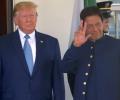
Trump spoke by telephone with Khan to discuss "the need to reduce tensions and moderate rhetoric with India over the situation in Jammu and Kashmir," the White House said in a readout of the call.

It would be foolish for Pakistan to assume that India would not act no matter what the provocation is, just because it is militarily more powerful than Myanmar and is armed with nuclear weapons, says Anand Kumar.

'If ever India loses its patience after repeated terror attacks and decides to retaliate against the terrorist camps, Pakistan may term that a conventional military attack and invoke the nuclear option. This is a way to continue with terrorism without retaliation.'
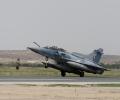
No one really knows what proportion of the nation's wealth and income are available for defence
.jpg)
Strongly hitting out at Pakistan for again raking up the Kashmir issue at the United Nations, India has said a constructive contribution cannot be expected from a country that has an established practice of hosting terrorists and is the "epicentre" of global terrorism, and the biggest destabilising force in the world.

Pakistan is a 'haven' for several Islamist terror groups and successive Pakistani governments are widely believed to have supported some outfits.
Voicing concern over growing nuclear stockpile in South Asia, Congress member of Parliament Mani Shankar Aiyar on Tuesday said that no other country is as threatened as India is by atomic weapons and prospect of these arsenal falling into the hands of terrorists.
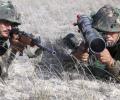
Here is how the two countries stack up militarily, according to a report in AlJazeera.com.

When asked if the Indian investigating agency would be allowed to visit Pakistan, Basit said that 'the whole investigation is not about reciprocity in view'.

Reining in Pakistan's expanding nuclear weapons programme should be an international priority, according to an editorial in the New York Times which said that the country being home to many extremist groups adds to the dangers it presents for South Asia and the entire world.
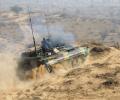
'Should the two armies clash in a conventional battlefield, the advantage will pass more and more to the Indians as the battle progresses,' says Brigadier S K Chatterji (retd).

The Western world keeps talking, ratcheting up sanctions, the only thing it can do. The Russians march on to Kyiv and capture Zelensky and key members of his government as part of their 'de-Nazification' drive, predicts Shreekant Sambrani.

'The combination of the LeT and the ISI is the most dangerous terrorist challenge in the world because it carries a real and present danger of provoking nuclear war.'

The Agni-V can reach beyond Tibet to high-value targets in the Chinese heartland, even its northern-most provinces.

The missile has a strike range of 2000 km, the sources said soon after it blasted off from a mobile launcher at the Launch Complex-4 of the Integrated Test Range, the sources said.
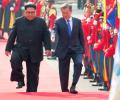
'Much depends on Moon's persuasive skill to make both Trump and Kim shed some of their rigidity and be flexible to accommodate contrarian viewpoints,' says Dr Rajaram Panda.
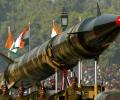
'We have worked to create road blocks in the path of those who thought that there was space for conventional war despite Pakistan's nuclear weapons.' 'Pakistan's nuclear weapons programme is not open-ended and aligned with India only.' 'In this unstable regional environment, one nuclear power is trying to teach lessons to another nuclear power through the medium of small arms and mortar shells on the Line of Control, and bluster.' 'A historic opportunity of a lifetime beckons the leaderships of India and Pakistan to grasp, sit together and explore the possibilities of conflict resolution.'
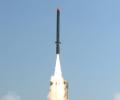
'So far, Pakistan leads India in subsonic cruise missile development, having tested and operationally deployed the Babur cruise missile that has a range of 700 km, significantly less than the Nirbhay's.'
How India engages with the world may have to change.

Keeping trusted men in key positions at Lahore, Rawalpindi and Peshawar has become vital for Bajwa, notes Rana Banerji, who headed the Pakistan desk at the Research and Analysis Wing, India's external intelligence agency.

The US needs to do three things to help the newly elected Nawaz Sharif government in Pakistan, says Stanley A Weiss

'A collapsing Pakistan may well unleash its nuclear weapons as the last throw of the dice. With a nuclear arsenal of over 50 bombs, even a regional nuclear exchange can devastate the world.'

When Pakistan Prime Minister Nawaz Sharif visits the White House on Wednesday, it will be his first encounter with an American president since that turbulent meeting with Bill Clinton when the Kargil war was raging 14 years ago.
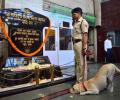
'We think Pakistan has moved decisively against terrorists that threaten Pakistan internally, but still needs to devote attention to those that represent a threat to their neighbours.'

When Pakistan Prime Minister Nawaz Sharif visits the White House on Wednesday, it will be his first encounter with an American president since that turbulent meeting with Bill Clinton when the Kargil war was raging 14 years ago.

Vice President Hamid Ansari discovers the iconic Fidel Castro in fine form during a rare 65-minute encounter. Nikhil Lakshman reports from Havana

It is time to throw an outer ring around India's national security by proactively engaging in areas immediately outside our neighbourhood. Such a ring will not only insulate India from emerging threats, but also create new leverage in securing our own neighbourhood, says Nitin Pai.

'It is strange that a country like India, which had gone through crisis after crisis resulting from militancy, insurgency and terrorist attacks, should still be practising ad hocism in managing its security imperatives,' says B S Raghavan, the distinguished civil servant and former member of the Joint Intelligence Council.
